
Exploring the Features of Medical Implant Devices
Titanium has many useful features including low specific gravity, half that of nickel, excellent corrosion resistance and strength, high biocompatibility, and non-magnetic properties useful for MRI application. With these advantageous features, titanium is an optimum material for medical prosthetic devices. To accommodate the wide range of increasing needs, Daido Steel has established a manufacture-logistics streaming system from raw material procurement to sales and distribution which is available for multiple products and small-lot.
Applications
| Classification | Parts Name | Material | |
| Implant | Artificial hip joint | Stem, cup | Pure titanium round bar Titanium alloy round bar |
| Artificial hip joint | Pure titanium round bar Titanium alloy round bar | ||
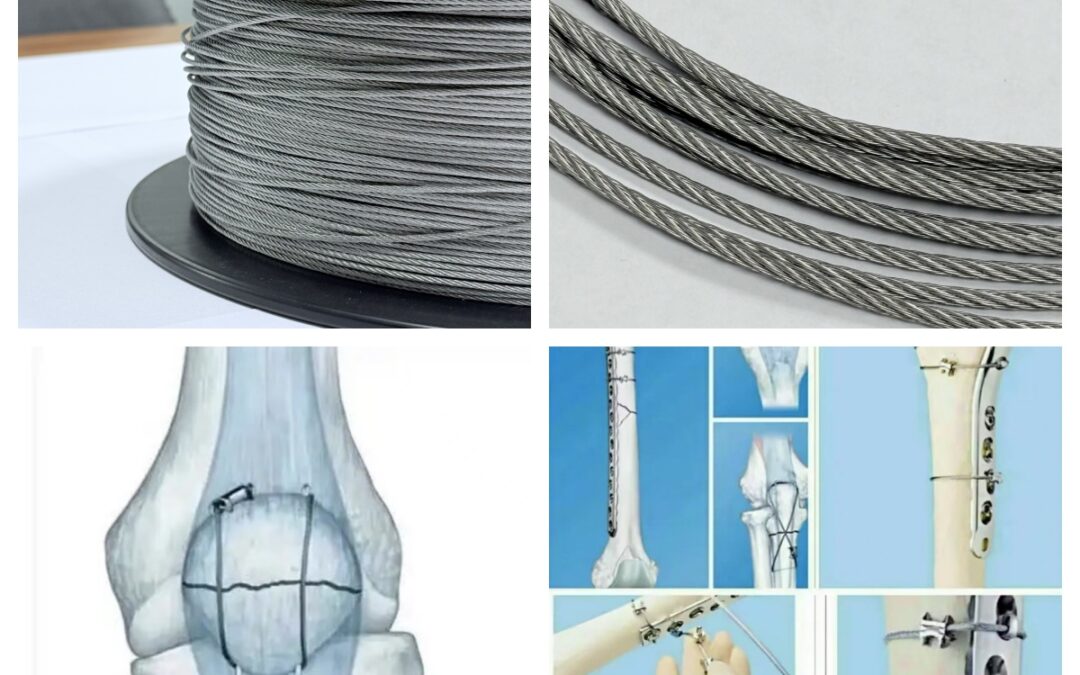
| Fracture fixation | Plate, screw | Pure titanium round bar Titanium alloy round bar Titanium alloy wire rod | |
| Artificial heart | Housing, case | Pure titanium round bar | |
| Artificial heart valve | Frame | Titanium alloy round bar | |
| Density | Artificial dental root | Titanium alloy round bar | |
| Jig | Handpiece | Pure titanium round bar | |
| Dentition fixation | Splint | ||
| Surgery | Cerebral aneurysm | Clip | Titanium alloy round bar |
| Brace | Titanium alloy round bar | ||
| Catheter guide wire | Ni-Ti alloy wire | ||
| Fracture surgery | Bolts | Pure titanium wire rod | |
| Body Sup. | Parts for artificial arms/hands/legs | Titanium investment-castings | |
Medical Titanium Wire gr5eli ASTM F136
Product Introduction
The titanium 6AL4V and 6AL4V ELI are suitable for medical applications, despite the fact that medical grade titanium wire is utilized in a variety of sectors. These are titanium alloys with aluminum (6%), vanadium (4%), and other metals. It is extremely compatible with the human body and is also referred to as grades 5 and 23. Worldwide, a number of distributors specialize in selling titanium materials of a medical grade.
Changsheng is a manufacturer of medical titanium implants and prosthesis fittings, as well as medical titanium bar/rod, medical grade titanium bar/rod, medical titanium alloy bar/rod, and medical grade titanium alloy bar/rod. Our items have been offered to Europe, Brazil, Southeast Asia, America and Taiwan, acquiring the great standing from our clients.
Applications
Certs: ISO9001-2015, ISO5832-3
Advantages
(1) density (20 ℃) = 4.5g/cm3, light weight. Implanted in human body: reduce the human body load, as a medical device: reduce the operating load of medical personnel.
(2) Low elastic modulus, pure titanium 108500mpa, implanted in human body: closer to the natural bone of human body, conducive to bone grafting, reduce the stress shielding effect of bone on implants.
(3) Non magnetic, not affected by electromagnetic field and thunderstorm weather, conducive to human safety after use.
(4) It is non-toxic and has no side effects on human body as an implant.
(5) Corrosion resistance (bio inert metal material), which has excellent corrosion resistance in the immersion environment of human blood, ensures good compatibility with human blood and cell tissue, does not produce human pollution as implants, and does not produce allergic reactions, which is the basic condition for the application of titanium and titanium alloy.
(6) High strength, good toughness, bone and joint damage due to trauma, tumor and other factors. In order to establish a stable bone scaffold, it is necessary to use arc plate, screw, artificial bone and joint, etc.
Exploring Medical Applications of Ultra-Fine Nitinol Wire
As the name alludes to, Nitinol is a nickel-titanium alloy known for its shape memory and super elastic characteristics. Shape memory refers to Nitinol’s ability to undergo deformation at one temperature, then recover its original, under formed shape upon heating above its transformation temperature. Super elasticity occurs at a narrow temperature range just above its transformation temperature; in this case, no heating is necessary to cause the under formed shape to recover. The material exhibits enormous elasticity, some 10-30 times that of ordinary metal.
It was initially discovered in 1968 in a search for mining materials. Still, it took decades for Nitinol to become useful in the marketplace due to the difficulties encountered in its processing and manufacturing. In fact, Nitinol’s many uses have mostly all been realized since the mid-1990s when its usefulness in a broad range of applications results derived from it being a shape memory alloys and its super-elastic properties. It is now widely used for many medical components, including re-enforcement braiding and coiling for catheter tubing and shafts, braided and formed stents, formed retrieval baskets, and many other applications. The shape memory makes it an excellent candidate for many in-body applications such as catheter re-enforcement and braided stents.
Nitinol is also used for these medical devices because it is bio-compatible, meaning it is compatible with the human body and will, therefore, not be harmful to human tissue. Other materials that are not bio-compatible can result in issues such as blood clotting when used for similar applications. Nitinol is generally produced in large cast ingots and can be subsequently processed all the way down to ultra-fine wires that are only a fraction of the size of a human hair. The final stages of the entire process are called wire drawing and require precision control in order to maintain physical and mechanical properties.
Ultra-fine wire is very small diameter (thickness) wire that is held to incredibly tight tolerances. Fine wire products are engineered with cutting edge on-line gauging to deliver outstanding dimensional precision and reliability. Nitinol is produced at Ulbrich in fine and flat wire forms with micro-scale diameter and widths and is then meticulously wound to guarantee tolerance consistency and ensure downstream performance. Nitinol wire in this form is a great choice for medical devices that may be introduced into the body to perform surgical procedures or treat diseases, and their mechanical properties play a significant role in the selection of metal for their manufacture.
Applications for Nitinol Wire
Medical device customers should also decide whether braid-enforced or coiled-enforced catheters are the best choice for their application. Many customers are now choosing to use Nitinol for coiled catheters in especially sensitive surgeries or other applications where accuracy is of utmost importance, such as cardiovascular or neural surgeries. The advantage of this is the superelasticity of Nitinol. It will act almost like a spring in that it can be stretched significantly and then return to its original shape. This is extremely beneficial in the medical field as the use often involves bending and twisting through arteries.
Another application for Nitinol wire in the medical industry is Braided Stents. Nitinol Stents are becoming more and more widely used in surgeries, especially to treat stenosis issues and issues below the knee. Nitinol stents would more so be used for the latter and is often a suitable choice for peripheral vascular disease, known as PAD. This is due to the force the nickel-titanium alloy can provide when it comes to holding open vessels, while still having enough elasticity to breathe.
The two applications above are the primary use of Nitinol round wire, but other applications include:
- Heat engines
- Resilient glass frames
- Orthodontic arc wire
- Medical devices
- Actuators
- High-reliability couplings
- Temperature control system couplings
Characteristics that Affect the Performance of Nitinol
There are multiple characteristics when it comes to producing and manufacturing this wire that will affect the final application: Physical characteristics, such as size and tolerance, and mechanical properties including tensile strength, elongation, and surface condition.
Physical Characteristics – Size and Tolerance
Size: Nitinol is very abrasive on wire drawing dies and has to go through these dies multiple times to achieve the small diameters required in the medical industry.
Tolerances: Tight tolerances need to be held when it comes to the diameter but just as important, need to be consistent throughout the entire length of the wire. This is beneficial not only to the end use but wear and tear on the drawing die.
Mechanical Properties – Tensile Strength, Elongation, and Surface Condition
The typical two conditions for Nitinol Ultra-Fine Wire are cold worked and straight annealed. The preference all depends on the processes of the customer and their manufacturing operations. Most of the wires will be heat set into super-elastic condition at the next manufacturing tier.
Controlling all of these characteristics throughout the wire and ensuring uniform dimensions will be essential to producing a good product and saving money in production. Precision equipment is required to keep these properties in check because even small inconsistencies will result in issues at the next manufacturing step in coil reinforcement, such as unusable parts or excess scrap.
Final Considerations of Ultra-Fine Nitinol Wire
Since Nitinol also has a unique ability to adapt to extraordinary strains and is compatible with the human body, it is finding numerous applications in the medical field. What starts as ultra-fine wire ends up being used for braid products such as stents, orthodontic wire, catheters, and other surgical implant devices. With end uses like these, it is essential for medical device manufacturers to select an alloy and a supplier that provides materials with undeviating, consistent mechanical properties, ensuring that those properties are appropriate for processing medical wire. Both production methods and manufacturing sources are equally important in supply chains within the high-tech medical device industry. For any further questions on Nitinol Fine Wire, please contact us, and we’ll be happy to answer any questions