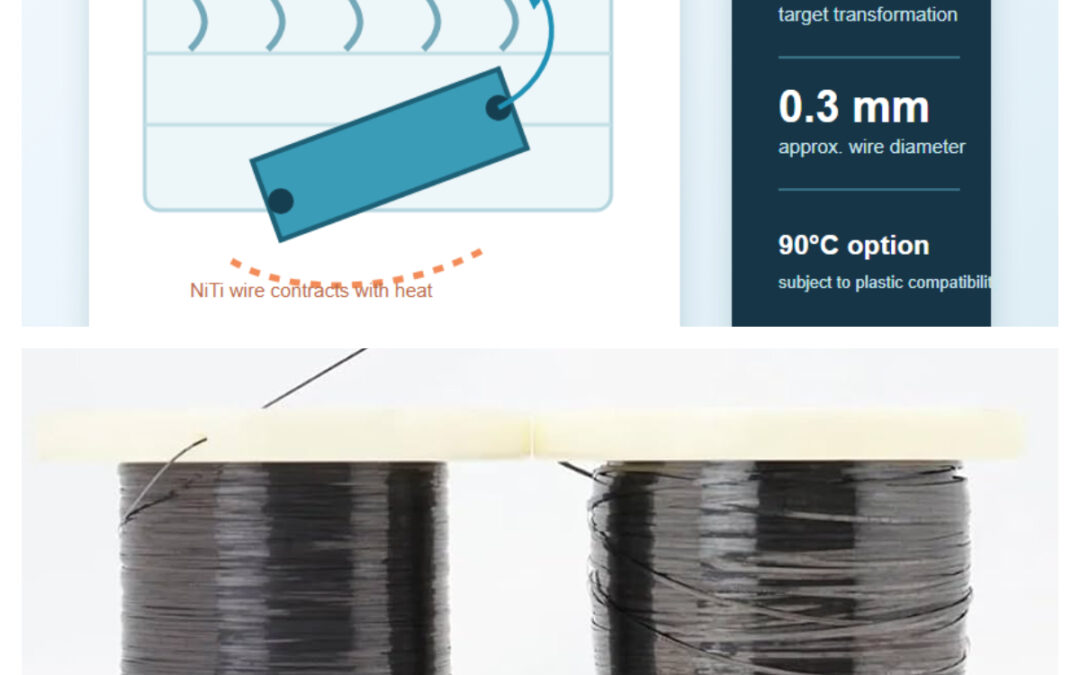
As North American home appliance manufacturers continue to pursue quieter, smaller, smarter, and more energy-efficient products, traditional motors, gears, and bulky mechanical assemblies are increasingly being replaced by compact functional components. NiTi shape memory alloy wire offers a practical solution for appliance applications that require reliable temperature-driven movement in a limited space.
Our NiTi shape memory wire is being developed for thermal actuation systems used in HVAC equipment, air-conditioning units, refrigerators, ventilation systems, smart dampers, temperature-sensitive valves, and other household appliances. When the wire reaches its designed transformation temperature, it changes shape and produces controlled mechanical force. This movement can be used to open, close, adjust, or position a mechanical component without relying on a conventional motor or complex transmission system.
For appliance designers, this principle creates new opportunities. A compact shape memory actuator can help control airflow direction, regulate a damper, adjust a valve, or activate a temperature-responsive mechanism. Its small size allows it to fit into narrow internal spaces, while its quiet operation is especially suitable for residential appliances where low noise is an important product requirement.
The current development target is a transformation temperature of approximately 60°C. This temperature range is being considered to balance actuation performance, product safety, response characteristics, and compatibility with common engineering plastics used in home appliances. A 90°C option may also be considered for applications requiring a higher operating temperature, subject to the heat-resistance limitations of the surrounding plastic parts, insulation materials, seals, and housing components.
The target wire diameter is approximately 0.3 mm. This fine diameter is intended to support lightweight, compact actuator designs while allowing engineers to evaluate stroke, recovery force, response time, and installation flexibility. Depending on the final application, the wire can be designed with different lengths, pre-strain conditions, bias springs, return mechanisms, or mechanical linkages. These factors can be adjusted to match the required movement and load of a specific appliance component.
Compared with traditional motor-driven mechanisms, a NiTi thermal actuator may offer several potential advantages: reduced component count, lower mechanical noise, smaller installation space, and a simplified mechanical structure. Because the actuation is directly related to temperature, the system can also be integrated into passive or semi-passive control concepts. This makes shape memory alloy technology attractive for applications where a simple temperature-triggered action is preferred.
Typical potential applications include automatic air-direction adjustment in air conditioners, ventilation damper control, temperature-sensitive valves, refrigerator airflow management, heat-activated safety mechanisms, and compact appliance controls. The final configuration will depend on the appliance structure, operating temperature, required force, stroke, cycle life, response time, and available installation space.
This product is currently at the development and sample-validation stage. It has not yet entered mass production. Before confirming a production specification, sample parameters must be reviewed and tested together with the customer’s application requirements. Recommended evaluation items include transformation temperature, actuation force, stroke, recovery behavior, heating and cooling response, cycle durability, connection method, corrosion resistance, and compatibility with the selected plastic housing and spring system.
We welcome cooperation with North American appliance manufacturers, component suppliers, and engineering teams that are developing new thermal control or airflow management products. Our goal is to confirm the right material parameters, provide application-specific samples, and support performance testing during the design stage.
The preliminary estimated annual usage is approximately 1 ton, subject to successful sample validation, product approval, and final project requirements. By working closely during the development phase, customers can evaluate the actuator’s performance before committing to a mass-production design.
NiTi shape memory wire brings compact, silent, and temperature-responsive motion to modern household appliances. For appliance projects seeking a smaller and simpler alternative to conventional actuation systems, this technology provides a promising foundation for the next generation of intelligent thermal control.
NiTi Shape Memory Alloy Wire Actuator for HVAC and Home Appliances