
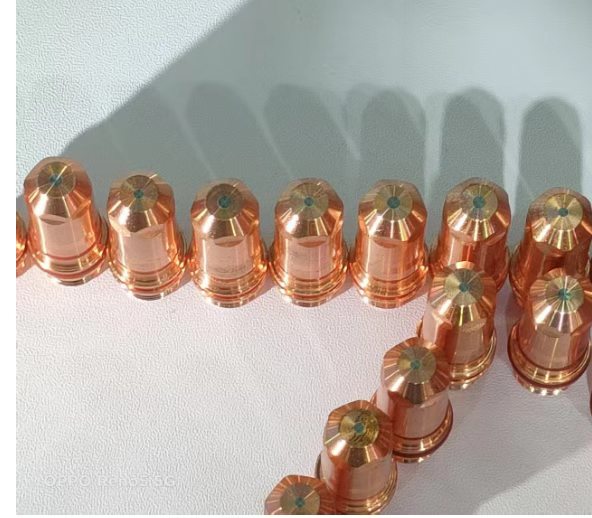
The quiet hero inside the torch
If you’ve ever run an air plasma cutter, one of those machines that plugs into an ordinary shop compressor, you’ve relied on a piece of metal about the size of a match head. Inside the electrode, embedded in the copper tip, sits a short length of hafnium wire. It’s the emission core, the part that actually starts and holds the plasma arc. Torch families like P80 and SG55 go through these electrode cores in enormous quantities, which is why hafnium wire is one of the best-known rare-metal consumables in the cutting industry.
And yet, most people who change electrodes every week have never thought about what’s inside them. Let’s fix that.
What happens inside the torch
An air plasma electrode is a two-part design: a copper body and a hafnium wire core, usually brazed or pressed in. Copper does what copper does best, carries current and pulls heat away fast. Hafnium does what no copper electrode can: it survives the arc.
When the torch fires, a high-voltage, high-frequency pulse pushes electrons out of the hafnium tip. Hafnium has a low work function, so it emits electrons readily. Those electrons establish the pilot arc, and the pilot arc ignites the main plasma arc. From then on, the hafnium wire is the anchor point, the arc root, for a plasma stream that runs at temperatures well above 10,000 °C. Hafnium’s melting point is 2,233 °C, which sounds absurd next to those numbers, but it isn’t the melting point that matters. What matters is that the copper behind the wire pulls heat out so fast that the hafnium tip keeps working far beyond what its melting point would suggest. Pure copper alone erodes within moments. Copper plus a hafnium core lasts.
The same properties explain why hafnium is the standard for air plasma in particular. Air plasma runs on oxygen or compressed air, and that oxygen is brutal on electrode materials. Hafnium’s behavior in that environment beats zirconium, which is why zirconium wire mostly lives in argon plasma, while hafnium owns the air plasma market.
What purity actually does to your cut
Here’s the part that matters when you’re buying wire. A high-quality electrode core is made from hafnium wire at 99.5% purity or better, usually supplied to ASTM B737 in two grades: R1 and R3. R1 carries stricter performance requirements and cleaner purity; R3 is the standard commercial grade with slightly more room on impurities. Either way, zirconium content is typically held to a maximum of 1.5%.
The impurity that deserves your attention isn’t zirconium, though. It’s oxygen. Hafnium with too much dissolved oxygen oxidizes and cracks under the arc, the arc root starts wandering, the electrode dies early, and the cut quality falls apart. More dross, more angle, more nozzle wear. High purity keeps the arc root locked in one spot, which means a stable arc voltage, a straight kerf, and a clean edge. Buy cheap wire and you’ll see the difference in the scrap bin, not on the invoice.
Coil wire and straight wire: same metal, different jobs
Hafnium wire is traded in two forms, and it’s worth knowing the difference because they serve different customers.
Coil wire is the raw form. Most buyers of coil wire aren’t electrode manufacturers at all, they’re processors. They take the coil, straighten it into straight wire, and then either cut it into small pellets or machine it, per drawing, into the pointed or shaped emitter inserts that go into electrode tips. If you’re selling wire, knowing who’s on the other end of the inquiry tells you which form they need, and how much tolerance they expect on diameter and straightness.
Straight wire, in cut lengths, sits closer to the finished end of the chain, and it tends to be specified more tightly.
What to check before you buy
A few things separate good hafnium wire from the wire that gives electrodes a bad name:
- Purity and gas content. Hafnium at 99.5% or better, low oxygen, zirconium within the 1.5% limit. Ask for the mill certificate, and actually read it.
- Grade clarity. R1 or R3? If the customer is making parts with performance requirements, R1 is usually the answer, and the supplier should be able to document it.
- Electrode makers run thousands of pieces. Wire with uneven diameter, surface defects, or batch-to-batch chemistry drift creates rejects they can’t afford.
- How it will be joined. Brazing the wire into the copper body beats a loose mechanical fit every time. Any gap means poor heat transfer, local overheating, a loose core, and a wandering arc. Much of what looks like bad wire is really bad assembly, and vice versa, so check both.
And one practical note for anyone using electrodes: when the hafnium tip has burned a pit about 1 to 1.6 mm deep, replace the electrode. Push it further and the arc root shifts, the nozzle takes the damage, and your cut quality disappears.
Reading the symptoms
Most plasma cutting problems trace back to the electrode, and the symptoms are quite specific:
- Hard to start, frequent misfires: the hafnium tip is oxidized or badly burned, or the wire core is loose.
- Wandering arc, crooked kerf, heavy dross: suspect low-purity wire or an off-center core.
- Nozzles burning out fast: the pit on the hafnium tip is too deep, the arc root has moved, and the arc is chewing the nozzle from inside.
None of these are mysterious. They’re all the same story: the emission core isn’t doing its job.
Why hafnium, not something cheaper?
We get asked this often, so here’s the honest comparison:
- Hafnium wire: the first choice for air plasma. Good life in oxygen-rich arcs, stable ignition, non-radioactive, and it works with ordinary compressed-air machines. Higher purity means longer electrode life.
- Zirconium wire: used mostly in argon plasma; erodes faster than hafnium in air.
- Thoriated tungsten: excellent heat resistance, but radioactive, and it’s being phased out wherever regulations or common sense apply.
- Pure copper: cheap, and it burns away almost immediately. Only useful for small currents and short cutting jobs.
The bottom line
Hafnium wire is a small part with an oversized job. Get the grade right, keep the impurities low, and respect the wear limit, and your electrodes will last. Skimp on any of it, and you’ll pay for it in misfires, dross, and nozzles.
We supply hafnium wire to ASTM B737 in R1 and R3, in coil and straight form, for electrode makers and processors around the world. If you’re sourcing emission-core wire, tell us your grade, diameter, and what you’re building. We’ll come back with a straight answer and a spec-matched quotation.