
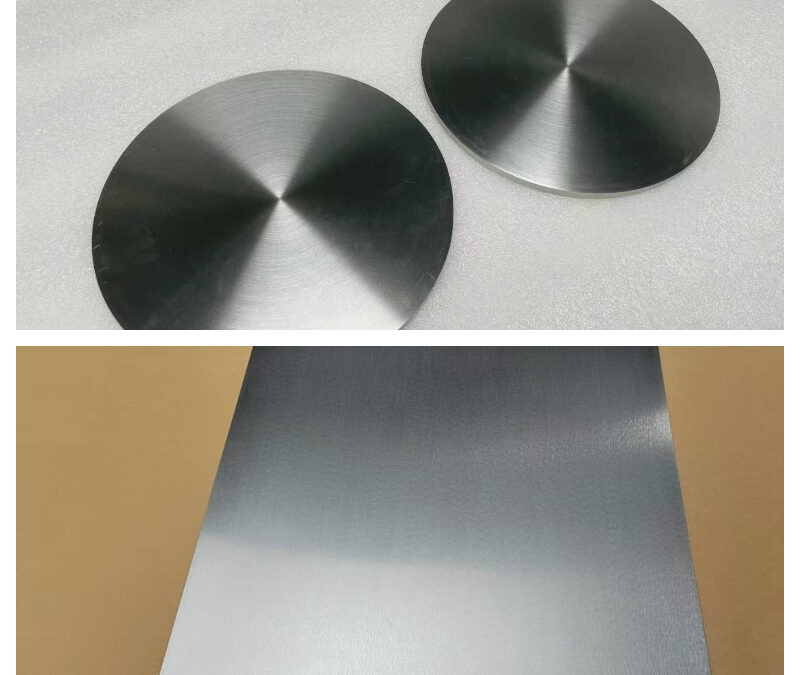
Why hafnium plate deserves your attention
Most buyers first meet hafnium as a tiny disc inside a plasma cutting torch. That is the metal’s most visible job, but it is only a fraction of the story. The real commercial weight of hafnium — especially in international trade — is carried by hafnium sheet and plate: rolled, flat, finished products that go into some of the most demanding engineering environments on Earth.
Hafnium is a silvery, ductile refractory metal with an extraordinary combination of properties:
- A melting point of 2,233 °C, among the highest of any practical metal;
- The strongest thermal-neutron absorption of any common structural metal, surpassing boron-based absorber materials in reactor service;
- Excellent thermionic emission, releasing electrons readily at high temperature;
- Outstanding resistance to many mineral acids, alkalis, and high-temperature water;
- Genuine formability — hafnium sheet can be stamped, deep-drawn, rolled, and machined, which is rare among refractory metals.
The governing standard for these flat products is ASTM B776, Standard Specification for Hafnium and Hafnium Alloy Strip, Sheet, and Plate, which defines two wrought grades: R1 for nuclear applications and R3 for commercial applications.
Know the product boundary: plate is not the electrode business
One of the most common positioning mistakes in hafnium trade is confusing plate with plasma-electrode material. Plasma torches overwhelmingly use hafnium discs or small embedded hafnium inserts — small, erosion-consumed components sold in high volume.
Hafnium plate, by contrast, is a finished engineering material. Its downstream customers are fabricators and OEMs building components for four concentrated sectors: nuclear energy, semiconductor/coating, aerospace & defense, and vacuum electronics. Each sector buys on a different specification, so the same “hafnium plate” listing actually covers several distinct products with very different quality regimes.
| Sector | Typical grade | Downstream finished products |
|---|---|---|
| Nuclear power (PWR, naval propulsion) | R1 nuclear-grade | Control blades, control-rod assemblies, in-core liners and structural parts |
| Semiconductor & coating | Electronic / high-purity | Sputtering targets (HfO₂, HfN), UHV chamber liners, sealing plates |
| Aerospace & defense | Alloy feedstock / engineering grade | Nb-Hf and Ta-Hf alloy billet, thermal-protection and flow-guide panels |
| Vacuum electronics & arc equipment | R3 industrial | X-ray tube cathode plates, high-voltage discharge-tube cathodes |
1. Nuclear industry — the highest-value market (nuclear-grade, R1)
Nuclear-grade hafnium plate is the premium track of this business, with demand concentrated in pressurized water reactors (PWRs) and naval propulsion reactors.
Key applications:
- Reactor control blades and control-rod plate assemblies. Hafnium absorbs thermal neutrons far more effectively than boron compounds, remains stable at in-core temperatures, and resists corrosion in hot pressurized water. Machined from plate into cruciform absorber blades, it regulates reactor power with exceptional reliability.
- In-core liners and structural components. The plate must survive years of high-temperature, high-pressure coolant and intense neutron irradiation without losing integrity.
Hard requirements nuclear buyers specify:
- Strictly controlled zirconium content — nuclear-grade material is commonly specified at Zr < 1%;
- High hafnium purity with tight control of interstitial gases (O, N) and hydrogen;
- Internal soundness — no inclusions, voids, or laminations, verified by ultrasonic inspection (UT);
- Annealed (recrystallized) condition with documented layered (directional) mechanical properties;
- Full chemical analysis and a complete mill test certificate.
2. Semiconductor and coating — high-purity electronic grade
In the semiconductor supply chain, hafnium is one of the most strategically important refractory metals, thanks to HfO₂ and HfN thin films.
Key applications:
- Sputtering target base material. High-purity hafnium plate is precision-machined into planar hafnium targets, then deposited by PVD to form HfO₂ and HfN films — used in advanced-chip high-k gate dielectrics, memory devices, optical coatings, and hard coatings.
- Ultra-high-vacuum (UHV) equipment liners and vacuum-chamber sealing plates. Hafnium’s low outgassing rate under vacuum and corrosion resistance make it a dependable material for semiconductor vacuum-chamber components.
Requirements electronic-grade buyers specify:
- Ultra-high purity, with every impurity element tightly budgeted;
- High surface finish (mirror or near-mirror);
- No subsurface inclusions — defects invisible in industrial plate can destroy a sputtering target;
- Controlled grain structure for uniform, repeatable deposition.
3. Aerospace and defense — high-temperature alloys and thermal management
Hafnium is the quiet backbone of several high-temperature alloy systems.
Key applications:
- Master-alloy and billet feedstock. Hafnium plate is forged and rolled into Nb-Hf and Ta-Hf high-temperature alloys used in rocket nozzle components, thermal-protection systems, and other high-heat aerospace hardware. Hafnium additions improve creep resistance and high-temperature oxidation resistance.
- High-temperature insulation and flow-guide panels for hypersonic vehicles, where components must survive transient ultra-high-temperature duty.
4. Vacuum electronics and arc equipment — industrial grade (R3)
Hafnium’s thermionic emission makes it a preferred cathode material.
Key applications:
- Cathode plate for X-ray tubes and high-voltage discharge tubes;
- Electron-emitting components in vacuum and arc equipment, where stable electron emission at high temperature is essential.
These are typically industrial-grade (R3) applications, where engineering properties matter more than nuclear-grade purity.
Our supply range
We supply hafnium sheet and plate to international buyers:
- Thickness: 0.5–20 mm
- Width: 50–1000 mm
- Length: 1000–2000 mm
- Standard: ASTM B776, Grades R1 / R3
- Options: annealed condition, ultrasonic inspection, full chemical analysis, and mill test certificates available on request
As a specialist rare-metal export supplier, we handle both the metallurgy and the paperwork. Send us your grade, dimensions, and application — we will respond with a specification-matched quotation and technical support.