
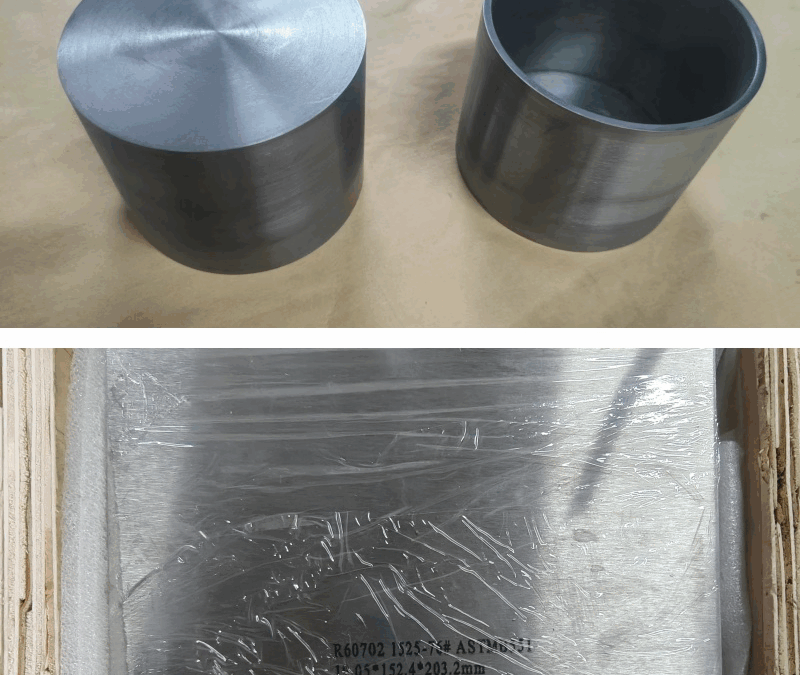
Ideal for specialized chemical environments (primarily acetic and hydrochloric acids), Zirconium and its alloys provide extreme corrosion resistance. Because it performs well in superheated water and it’s transparent to thermal neutrons, zirconium has been used since the 1950s as cladding for nuclear fuels. Although it’s still used in water-cooled nuclear reactors, the list of beneficial applications for zirconium and its alloys continues to grow. The material is also used in the chemical processing industry for flashbulbs and incendiary ordnance, as well as gettering material in sealed vacuum devices. It’s also useful for construction materials.
United Titanium carries two common grades – 702 and 705. As a commercially pure grade, zirconium 702 offers excellent corrosion protection with resistance to stress-corrosion cracking and crevice corrosion. It’s often used for chemical processing. Alloyed with 2 to 3 percent Columbium, zirconium 705 is significantly stronger and more ductile than zirconium 702 with almost equal corrosion resistance, making it the alloy of choice for most zirconium fasteners.
Resistant to corrosion in most organic and mineral acids, alkalis, and some molten salts, zirconium gets its protection from a critical oxide layer produced on the surface by heat treatment. Other than the natural regeneration of oxide that occurs when oxygen is present, zirconium oxide can be formed or enhanced by anodizing or by heating in air, water, or steam. To provide the most enhanced oxide layer on machined parts, especially on threaded fasteners, it’s crucial that these parts are heat treated to specific parameters.
Zirconium 702
Zirconium 702 is a commercially pure Zirconium. Zirconium is a reactive metal that has a high affinity for oxygen resulting in the formation of a protective oxide layer in air at room temperature. This protective oxide gives Zirconium alloys their superior corrosion resistance. This oxide layer can be enhanced through a heat treating process. A properly formed enhanced oxide layer serves as an excellent bearing surface against a variety of materials, imparts impressive erosion resistance in high velocity systems and can improve the corrosion resistance in certain aggressive environments.
Zirconium alloys exhibit good ductility even at cryogenic temperatures and good strength comparable with other common engineering alloys.
| Zirc 702 | Carbon C |
Iron+Chromium FE+Cr |
Hydrogen H |
Hafnium Hf |
Nitrogen N |
Oxygen O |
Zirconium+Hafnium Zr+Hf |
| <=0.05 | <=0.2 | <=0.005 | <=4.5 | <=0.025 | <=0.16 | >=99.2 |
Zirconium 705
Zirconium 705 is alloyed with Niobium to increase its strength and improve its formability. Zirconium is a reactive metal that has a high affinity for oxygen resulting in the formation of a protective oxide layer in air at room temperature. This protective oxide gives Zirconium alloys their superior corrosion resistance.
This oxide layer can be enhanced through a heat treating process. A properly formed enhanced oxide layer serves as an excellent bearing surface against a variety of materials, imparts impressive erosion resistance in high velocity systems and can improve the corrosion resistance in certain aggressive environments.
Zirconium alloys exhibit good ductility even at cryogenic temperatures and good strength comparable with other common engineering alloys.
| Zirc 705 | Carbon (C) |
Iron+Chromium (FE+Cr) |
Hydrogen (H) |
Hafnium (Hf) |
Nitrogen (N) |
Niobium (NB) |
Oxygen (O) |
Zirconium+Hafnium (Zr+Hf) |
| <=0.05 | <=0.2 | <=0.005 | <=4.5 | <=0.025 | 2.0-3.0 | <=0.18 | >=95.5 |
Specifications
| Common Name | UTS (ksi) | YS (ksi) | EI (%) | Ra (%) |
| min. | min. | min. | min. | |
| Z702 | 55 | 30 | 16 | – |
| Z705 | 80 | 55 | 16 | – |
Zirconium Mechanical Properties
Zirconium 702 Material Specifications
| ASTM/ASME B/SB493 | Rod (Bar), 3 1/2″ diameter and larger |
| ASTM/ASME B/SB550 | Rod (Bar), 3″ diameter and smaller |
| ASTM/ASME B/SB551 | Plate, Sheet and Strip |
| ASTM/ASME B/SB658 | Pipe |
| ASTM/ASME B/SB523 | Tube |
| ASTM/ASME B/SB653 | Fittings |
Zirconium 705 Material Specifications
| ASTM/ASME B/SB493 | Rod (Bar), 3 1/2″ diameter and larger |
| ASTM/ASME B/SB550 | Rod (Bar), 3″ diameter and smaller |
Zirconium 702 and 705 are both common grades of zirconium alloy, but they differ in their composition and properties. Zr702 is essentially commercially pure zirconium, while Zr705 is an alloy with niobium added to improve its strength and formability. Zr705 generally has higher strength and ductility than Zr702, while Zr702 often exhibits slightly better corrosion resistance in certain applications.
Here’s a more detailed breakdown:
Zirconium 702
- Composition: Primarily zirconium with small amounts of other elements like hafnium.
- Properties: Excellent corrosion resistance, particularly in organic and mineral acids. Good fabricability.
- Applications: Chemical processing equipment, heat exchangers, and piping systems in corrosive environments.
Zirconium 705
Composition:
Zirconium alloyed with niobium (typically 2-3%), which enhances its mechanical properties.
Properties:Significantly higher strength and ductility than Zr702. Good corrosion resistance, though potentially slightly less than Zr702 in some cases.
Applications:Nuclear reactors, aerospace and military components, and equipment in highly corrosive chemical environments where high strength is crucial.
Key Differences Summarized:
| Feature | Zr702 | Zr705 |
| Composition | Commercially pure zirconium | Zirconium alloyed with niobium |
| Strength | Lower | Higher |
| Ductility | Lower | Higher |
| Corrosion Resistance | Generally good, potentially better in some environments than Zr705 | Generally good, but can be slightly lower in some environments than Zr702 |
| Typical Applications | Chemical processing, heat exchangers | Nuclear reactors, aerospace, high-strength applications in chemical processing |
Applications of Zirconium Alloys
Different zirconium alloys are utilized across various industries due to their distinct mechanical properties and exceptional resistance to corrosion.
Zirconium 702
With its excellent corrosion resistance, particularly in acidic and chloride-rich environments, Zirconium 702 is commonly used in chemical processing industries. It plays a crucial role in manufacturing acid storage tanks, heat exchangers, and piping systems that handle aggressive chemicals. Its ability to withstand seawater exposure makes it a preferred choice for marine applications, including seawater-resistant components. Additionally, its biocompatibility allows for use in medical implants and prosthetics, ensuring durability and compatibility with the human body. The aerospace and defense sectors also incorporate Zr 702 in select components where corrosion resistance is critical.
Zirconium 705
Offering the highest strength and corrosion resistance among the three alloys, Zirconium 705 is a key material in nuclear power plants. It is commonly used in structural components and reactor core parts, where material integrity is crucial for safety and longevity. The aerospace and military industries rely on Zr 705 for applications that demand both high strength and resistance to extreme environmental conditions. In industrial sectors dealing with highly aggressive chemicals, Zr 705 is an essential choice for equipment exposed to extreme chemical environments, ensuring prolonged service life and reliability in harsh operating conditions.
Conclusion
Choosing the right zirconium alloy depends on the specific requirements of your application:
Zr 702 is best suited for applications requiring high corrosion resistance and ease of fabrication.
Zr 705 is the best choice for high-strength applications, particularly in nuclear, aerospace, and chemical industries.
XOT metals offers a wide range of zirconium pipes and tubes in various sizes and grades. Three distinct grades are available to suit different application needs. XOT metals also manufactures zirconium strips, pieces, and wires. Zirconium alloys and compounds are also available for specialized applications. For custom zirconium pipes or further information, please contact us for more details.