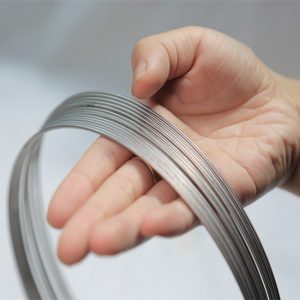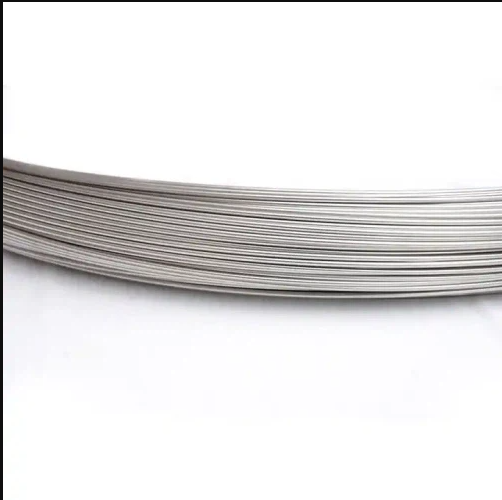
Nickel-titanium wire are the fabricating product of nickel-titanium alloy. Nickel-titanium is well known for its thermo-mechanical properties of superelasticity and shape memory effect. Shape memory refers to the ability of Nitinol to undergo deformation at one temperature and then recover its original, under formed shape upon heating above its transformation temperature. Super elasticity occurs at a narrow temperature range just above its transformation temperature; in this case, no heating is necessary to cause the under formed shape to recover, and the material exhibits enormous elasticity, some 10-30 times that of ordinary metal. Nitinol is a nickel-titanium alloy with the typical ratio 40-50% nickel, 50-60% titanium known as a shape memory alloy (SMA), a metal alloy that demonstrates pseudo-elasticity and the shape memory effect. The shape memory effect is when a material returns to its pre-deformed shape by heating. These unusual properties are being applied to a wide assortment of applications in a number of different fields including the medical device and aerospace industries.
AF Temperature Water Bath Method Detection Introduction
1. The water bath method for detecting AF temperature begins by taking a slice from the melted ingot. This slice is then used as a sample to confirm the composition of the ingot, so as to proceed with the melting process.
2. After the finished product is made, samples will be taken from the finished product. First, the sample is prepared. A section is taken and then the sample is made at a temperature of -25°C (bend the wire and then fold it), and then placed in water to heat up. At what temperature can it return to a straight line by 90% to determine the final AF temperature of the product.
3. The sample of the ingot and the sample taken from the final finished product will be the same in total quantity, but the numbers may not be in one-to-one correspondence. However, at least the total quantity is consistent. (The water bath method for detecting AF temperature has a record sheet and video.) A single water bath test takes 5 minutes.
AF Temperature DSC Detection Introduction
DSC detection is carried out by sampling from the sample taken from the water bath method, approximately 10mg in weight, and weighing it on the weighing platform. After weighing, it is directly placed in the equipment for detection. First, it is cooled down, then heated up, and the curve is observed. After the curve is generated, the specific position of the curve parameters is selected. Generally, the position of the horizontal line is found, and then the parameters are taken. Thus, the AF value and AS value are obtained. Then, when the temperature at this point has completely dropped, a new sample is selected for detection.
The operation takes approximately 10 minutes.
Recommendation: Always calibrate before each operation and make records.
Comparison
DSC is currently a commonly used method for testing,
The water bath method is simple to operate and has relatively simple equipment requirements.
In the case of DSC, the requirements for the operators’ skills and the equipment itself are higher.
If the professional level of the equipment or the personnel is insufficient, significant errors will occur. 。 Both can be measured. It all depends on the situation and the choice of the most appropriate method.