
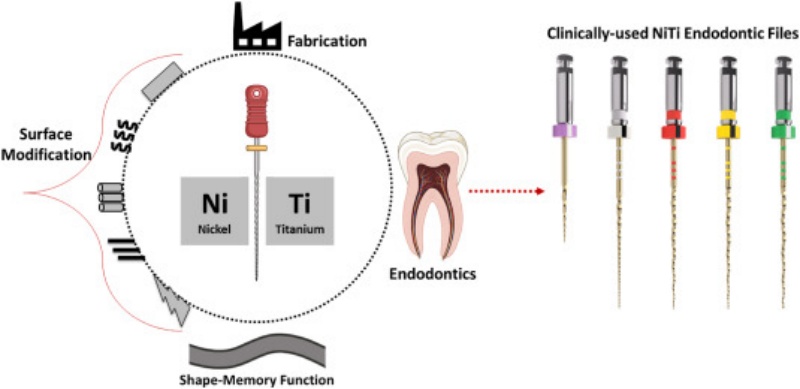
Choosing good-quality NiTi (Nickel-Titanium) raw material is essential in the production of endodontic NiTi files due to several critical factors that directly impact the performance and reliability of these dental instruments. Here are key reasons why selecting high-quality NiTi raw material is crucial:
Biocompatibility
Dental instruments, including endodontic files, come into direct contact with patients’ oral tissues. High-quality NiTi raw material ensures biocompatibility, minimizing the risk of adverse reactions or sensitivities in patients.
Flexibility and Superelasticity:
NiTi files are known for their unique properties of flexibility and superelasticity. High-quality raw material ensures that the endodontic files maintain these characteristics, allowing for efficient navigation through curved root canals without fracturing or permanent deformation.
Resistance to Fatigue:
Endodontic files undergo repetitive bending and twisting during use. Good-quality NiTi raw material is essential to provide resistance to cyclic fatigue, ensuring that the files maintain their structural integrity and performance over time.
Corrosion Resistance:
NiTi files are exposed to the oral environment, which may contain various substances that can lead to corrosion. High-quality raw material with proper alloy composition enhances corrosion resistance, extending the lifespan of the endodontic files.
Manufacturability:
The quality of NiTi raw material affects its machinability and the ability to undergo manufacturing processes such as grinding, shaping, and heat treatment. High-quality material allows for precision manufacturing, resulting in consistent and reliable endodontic files.
Predictable Transformation Temperatures:
NiTi alloy undergoes phase transformations (e.g., from austenite to martensite and vice versa) at specific temperatures. Controlling the composition of high-quality raw material ensures predictable transformation temperatures, influencing the performance of the endodontic files during clinical procedures.
Reduced Risk of File Separation:
Good-quality NiTi material contributes to the structural integrity of endodontic files, reducing the risk of file separation during use. File separation can lead to complications and challenges in root canal procedures.
Precision in Manufacturing:
High-quality NiTi raw material allows for precise manufacturing processes, enabling the production of endodontic files with consistent dimensions, shapes, and cutting features. This precision is critical for the efficacy of the files in clinical applications.
Compliance with Standards:
The dental industry often has standards and specifications for the materials used in the production of dental instruments. Choosing good-quality NiTi raw material ensures compliance with these standards, promoting the safety and efficacy of endodontic files.
Enhanced Clinical Performance:
Ultimately, the use of high-quality NiTi raw material contributes to the overall clinical performance of endodontic files. Practitioners can rely on instruments that are durable, reliable, and well-suited for the demands of root canal procedures.
In summary, selecting good-quality NiTi raw material is a fundamental step in producing endodontic NiTi files that meet the demanding requirements of the dental industry. It ensures the safety of patients, enhances the performance of the instruments, and contributes to the overall success of root canal treatments.
Conventional NiTi Alloys used in Endodontics
The main advantage of using NiTi alloys in root canal shaping instruments is the alloy’s high flexibility.8 Martensitic transformation can be stress induced from the austenitic phase over a narrow range of temperatures. Superelasticity occurs when a large reversible deformation occurs while increasing, stress appears to be constant (plateau). It happens as follows: Conventional NiTi alloys are in the austenite phase at body/room temperatures Activation of austenitic NiTi produces an elastic deformation that follows a linear stress/strain function (the slope of the curve representing the elastic modulus). If deformation (stress) increases, the superelastic deformation appears, whereas strain remains constant. This superelastic behavior is a direct consequence of the martensitic transformation which occurs at the crystal lographic level. The strain will remain constant until the entirety of the NiTi mass has shifted to the martensitic, which in turn will sign the end of the superelastic domain.Continuing the activation beyond that point will reveal conventional martensitic deformation with a classic linear stress/strain relationship as the crystallographic deformation’s potential to absorb strain is exhausted.8 Thus, if the load is relieved before reaching the plastic deformation limit, the deformation will be reversible, both ordinary austenitic elasticity and the pseudoelastic deformation due to phase change.
Again, as for thermal modification, the hysteresis phenomenon is present and the loading and unloading curves will not match. It is noteworthy that although the mechanism of action is similar, the aspect of stress–strain curves will vary significantly epending on the diameter of the wire, temperature, and annealing properties. Having tested instruments from several manufacturers, Ounsi et al established that the earlier generations of instruments were all manufactured from a unique 55%Ni–45%Ti. This becomes obvious when one considers that transformation temperatures of such alloys are highly sensitive to the composition and even 1% deviation in these percentages would almost yield a 100°C temperature threshold shift. As a direct consequence, melting plants must meet strict requirements in controlling nickel to titanium ratios to obtain the required final transformation temperatures. Since NiTi alloys work harden rapidly, they cannot be cold-processed. Circular section wires are instead manufactured through diedrawing processes. For that, multiple reductions and frequent interpass annealing in the 600 to 800°C range are required to yield the required product. When observed under scanning electron microscopy at high magnification, fractured surfaces of NiTi instruments revealed small voids regularly distributed throughout the bulk of the alloy.They are due to the manufacturing process because when nickel and titanium ingots are melted together in a carbon crucible, there is a diffusion speed differential between the two elements inasmuch as the speed of diffusion of nickel atoms into the titanium ingot is different from that of titanium atoms inside the nickel ingot, which in turn creates voids known as Kirkendall porosities.It is noteworthy that the distribution and size of these porosities reflect the specific metallurgical processing of the alloy. These Kirkendall porosities seem to have an influence on the mechanical behavior of the alloy. Nagumo hypothesized a hydrogen uptake into the alloy from oral liquids. This hydrogen would then move through interstitial sites, dislocations, and grain boundaries creating hydride phases that are responsible for hydrogen embrittlement. Asaoka et al have reported that these hydride phases form primarily near the alloy surface. Furthermore, since the thickness of the subsequent brittle layer is variable, microcracks form on the surface when external forces induce deformation or abrasion. Thus, hydrogen adsorption is very likely to be an important factor in determining the lifespan of NiTi when subjected to biologic media. It is unlikely that this would pose an issue during regular clinical use since there might not be sufficient time for the phenomenon to occur; however, it might become relevant during disin fection or sterilization protocols where the alloy would be in contact with ionized fluids for extended periods.
Surface Treatment of NiTi Alloys
Since the alloy could not be changed at the time, alternative strategies to improving instrument behavior consisted in surface modification techniques that intend to avoid microcrack formation, which is a nucleation point leading to failure. The purpose was to enhancesurface strength without changing bulk properties, such as superelasticity and toughness. One of these processes, electropolishing, is an electrochemical process that reduces surface irregularities (in contrast to electroplating where an electric current is used to deposit metallic ions onto one of the electrodes). The instrument is placed in a temperature-controlled electrolytic bath and connected to the positive terminal. When the direct current passes through the anode, the metal on the surface is oxidized and dissolved in the electrolyte. To electropolish a rough metallic surface, the extruding areas at the surface should be removed faster than depressions and surface imperfections due to the orientation of the crystals in a polycrystalline material should be suppressed without pitting. This is usually performed with specific ionic solutions and under rigorous (and generally proprietary) manufacturing control. This process is supposed to improve material properties, specifically fatigue and corrosion resistance; however, the evidence is controversial. Some authors found an extension of fatigue life for electropolished instruments while most did not. Moreover, Boessler et al suggested a change in cutting behavior with an increase of torsional load after electropolishing; however, cyclic fatigue was reduced. One possible reason for these variations is the different testing environments used in these experiments. A recent paper testing the effect of electropolishing confirmed these facts and correlated the depth of the machining grooves to the variations in number of cycles to fracture: The deeper the grooves, the lower the fracture resistance. Another approach to polishing is used for the twisted files (SybronEndo, Orange, CA, USA) and consists in treating the surface of the instrument with a proprietary Deox treatment. This Deox treatment appears to be similar to chemical polishing; the latter is typically done by subjecting the part to a cleaning solution (usually acidic) without the use of an electric current. As for electropolishing, there is little indication that chemical polishing would cause any effect on the mechanical properties of theunderlying metal since the changes are limited to a few nanometers to a few micrometers from the very surface.Physical vapor deposition is a process that allows coating of NiTi instruments with a layer of titanium nitride that confers a golden color to the surface of the instrument. The result is an improvement in cutting efficiency and corrosion resistance without affecting the superelastic properties. Another process is plasma immersion or ionic ion implantation. It is obtained by changing the subsurface layer of the alloy using accelerated ions (plasma or ion gun) and was reported to increase the cutting efficiency without affecting the bulk characteristics of treated instruments. Tripi et al observed that nitrogen deposition would force elemental nickel from the surface inward,toward the core of instruments. This was corroborated by Alves-Claro et al. However, one study showed that nitrogen ion implantation reflected negatively on the performance of such instruments when tested for fatigue. The authors attributed this negative file performance to nitrogen diffusing along grain boundaries instead of creating titanium nitride to surface harden the alloy. Finally, one study considered boron implantation and reported that implanting boron into NiTi alloys had the potential of drastically improving cutting efficiency without hindering their superelastic properties. Boron-implanted NiTi alloys had their surface hardness doubled when compared with pure Nitinol alloys at 0.05 μm depth. The surface hardness of this modified NiTi alloy exceeded that of stainless steel. Finally, surface hardening can be achieved through cryogenic treatment. The samples tested showed increased microhardness but no detectable change in crystalline phase composition or elemental composition. This was also confirmed by another study that concluded that deep dry cryogenic treatment “increases the cutting efficiency significantly but not the wear resistance.” A similar study was conducted pertaining to shape memory alloys. It concluded that deep dry cryogenic treatment with 24 hours soaking period significantly reduced the hardness (and by extension reduced the likelihood for fracture), but it also reduced the wear resistance of shape memory NiTi alloys.
CONCLUSION
New alloys, NiTi or otherwise, are continuously introduced in endodontics. The alloy is but one of several variables affecting possible mishap occurrence during the instrumentation phase. Instrument design and root canal anatomy are also key variables affecting clinical performance. However, the most important variable remains the operator who is entrusted in handling the instruments. He or she should be just as much knowledgeable in the influence of alloy characteristics on the performance of the instrument they are using, as they should be regarding root canal anatomy or instrument design. This is key to ensure safety and efficiency during instrumentation.