
Introduction
- Two niobium alloys have emerged as frontrunners for high-temperature applications in rocket
propulsion systems: C103 (Nb-10Hf-1Ti [wt%]), and Nb521 (Nb-5W-2Mo-1Zr [wt%]).
- C103 has historically provided satisfactory manufacturability/high-temperature performance, yet it is expensive due to the Hf content.
- C103 is typically employed with a hightemperature oxidation-resistant coating (Si-20Cr-20Fe, tradename: R512E) that enables operation temperatures up to 1400 °C.
- Nb521 leverages solid solution strengthening from W and Mo additions as well as precipitation strengthening via the formation of ZrC and Nb2C.
- Nb521 paired with MoSi2 coatings, exhibits a claimed 3 to 5 times greater high-temperature strength at 1600 °C compared to C103. [1]
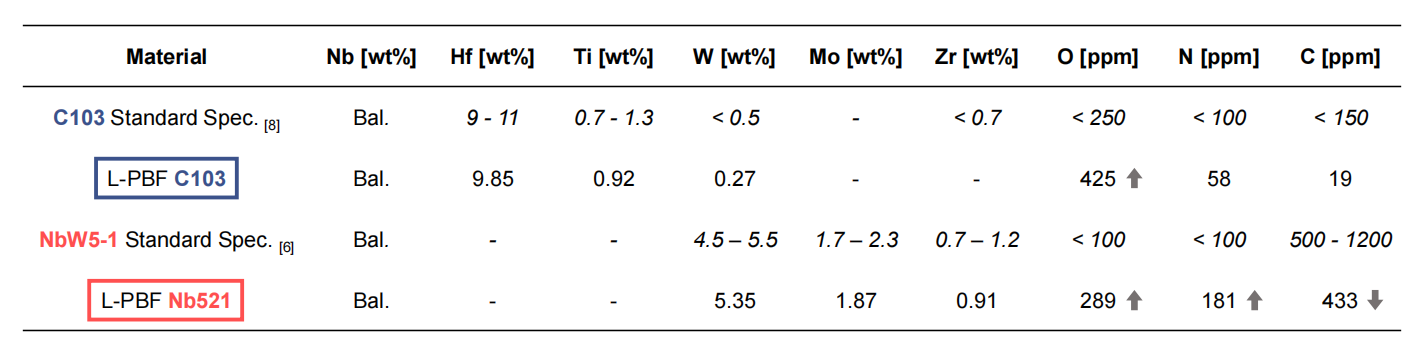
Chemical Composition •
Determined via SEM-EDS and LECO Combustion analysis
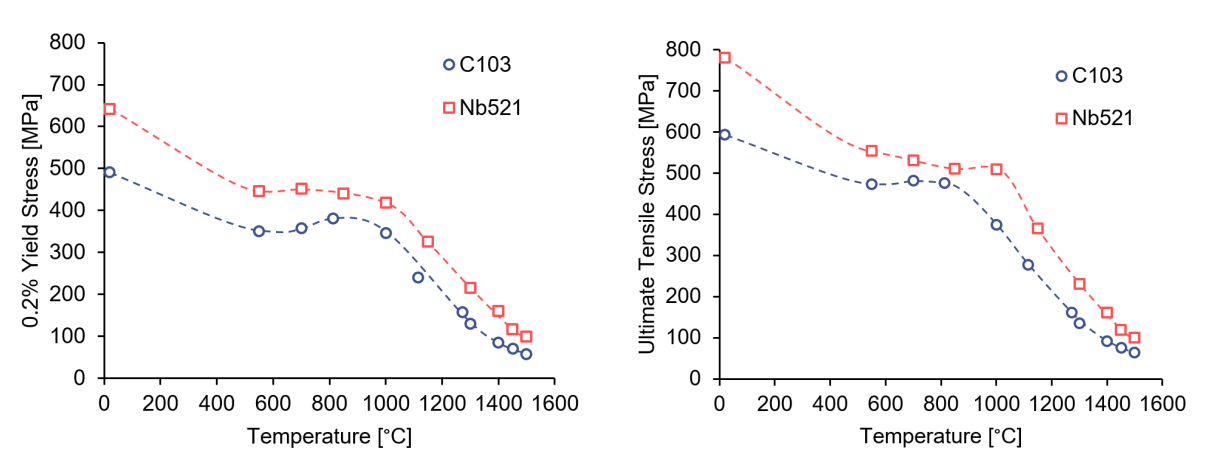
Elevated Temperature Uniaxial Tensile Testing www.nasa.gov 12 • Nb521 has a ~70 MPa greater yield strength compared to C103 across the entire examined temperature range.
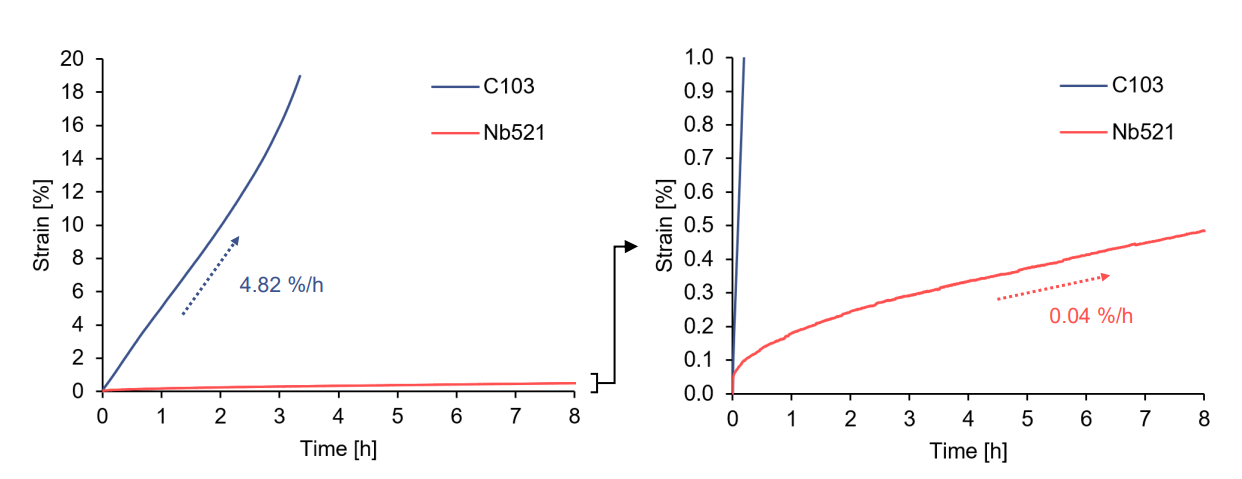
Elevated Temperature Constant Load (Pseudo-creep) www.nasa.gov 13 • At 1300 °C and a constant load of 50 MPa, Nb521 has a creep rate nearly 2 orders of magnitude lower than C103.
Comparing Performance, Cost, and Other Properties
- Qualitatively, C103 has anincreased printability window.
- C103 is only marginally less densethan Nb521.
- Nb521 outperforms C103 inelevated temperature strength,creep resistance, and maximumcoated operating temperature.
- Despite the estimated raw materialcost of Nb521 being significantly lower, recent purchases of spherical powder for L-PBF have only shown only ~20% reduction in price per kg.
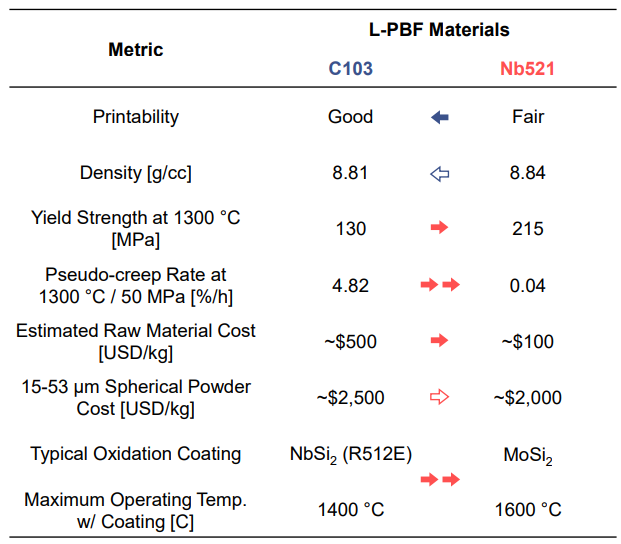
Conclusions
- Nb521 was successfully consolidated via the L-PBF process and achieved a relative density matching that of C103 (99.96 and 99.92%, respectively). A slight increase in the volumetric energy density was required for Nb521 L-PBF (138.9 vs 114.6J/mm3).
- Elevated temperature tensile testing showed that Nb521 has greater yield and ultimate tensile strengths compared to C103 from room temperature up to 1500 °C.At temperatures above 1400 °C, Nb521 had nearly double the strength of C103.
- Constant load (50 MPa) tensile testing (pseudo-creep) at 1300 °C determined thatNb521 is approximately 100X more creep resistant than C103 with steady-state creep rates of 0.04 %/h and 4.82 %/h, respectively.
- Microstructural analysis of the 1500 °C tension specimens showed both Nb521 and C103 experienced recrystallization and precipitate coarsening. However, the coarsened zirconium-rich precipitates in Nb521 were more likely to be observed at grain boundaries indicating greater thermal stability
Development of high temperature niobium alloys and C103,Nb521
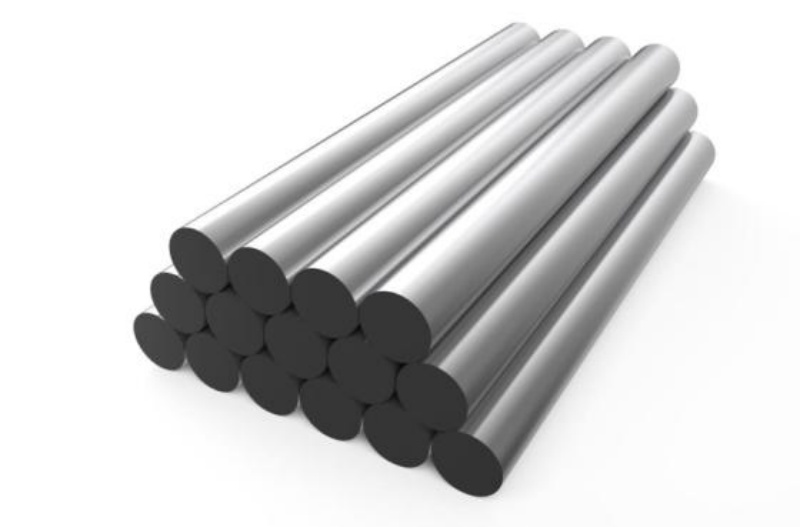
Compared with other kinds of superalloys, high temperature niobium alloy has the advantages of low density, high temperature (600~1600 ℃) specific strength, good cold and hot forming performance, good welding performance, etc., can be processed to form thin-wall and complex shape parts. Thrust chamber body extensions for attitude control/orbit control engines for rocket engines, satellites, spacecraft and missiles are one of the important candidate materials for aerospace structural components.
In aerospace, the most used is C-103 and Nb521 alloys, at present, orbit control/attitude control engine refractory metal material thrust chamber has formed a “two generation” series of products. Among them, the “first generation” is niobium hafnium alloy (i.e. C-103) and the “815” coating system, and the “second generation” is niobium tungsten alloy (i.e. Nb521) and the “056” coating system. C-103(Nb-10Hf-1Ti) alloy is a kind of low strength niobium alloy with good high temperature strength, excellent formability and weldability, which is widely used in rocket propulsion and other fields. The alloy is manufactured in China and applied to the two-component liquid rocket engine, and the niobium silicide high temperature anti-oxidation protection coating is used, and the working temperature can reach 1200~1300 ℃. Good formability and stable reliability make C-103 niobium alloy with excellent cost performance, and further promote its application in the field of aerospace.
Due to the limitation of the use temperature and high temperature mechanical properties, C-103 alloy and niobium silicide anti-oxidation coating have been difficult to meet the growing needs of spacecraft. Therefore, Nb521(Nb-5W-2Mo-1Zr) niobium alloy has been developed in our country on the basis of 5Β μ-niobium alloy from the Soviet Union. The alloy uses a high temperature anti-oxidation coating of molybdenum silicide, which increases the operating temperature to about 1550 ° C, significantly reducing the flow rate used to cool the combustion chamber propellant, and thus effectively increasing the specific impact of the engine.
Nb521 niobium alloy is a medium strength plastic niobium alloy by adding W, Mo, Zr alloying elements and a small amount of C elements to the niobium matrix, which further improves the mechanical properties of niobium alloy at room temperature and high temperature by means of solid solution strengthening and precipitation strengthening.
What is the difference between Nb521 and C103 Niobium alloy?
C-103 (Nb-10Hf-1Ti) alloy is a sort of low-strength niobium alloy with accurate high-temperature strength, extremely good formability and welding performance, which is broadly used in rocket propulsion and different fields, and is a variety of niobium alloy with a huge vary of applications. Our united states of america imitates this alloy utilized in two-component liquid rocket engine, and adopts niobium silicide high-temperature anti-oxidation safety coating, the working temperature can attain 1200~1300 ℃.
Good forming residences and secure reliability make C-103 niobium alloy has exquisite value performance, and in addition promote its utility in the aerospace field.
Due to the boundaries of working temperature and excessive temperature mechanical properties, C-103 alloy and niobium silicide anti-oxidation coatings have been challenging to meet the evolving wants of spacecraft. For this reason, China has developed Nb521 (Nb-5W-2Mo-1Zr) niobium alloy on the groundwork of Soviet 5ΒΜЦ niobium alloy. The alloy is lined with molybdenum silicide for high-temperature safety in opposition to oxidation, which will increase the running temperature to round 1550 °C, extensively lowering the drift of propellant used to cool the combustion chamber, therefore correctly growing the particular impulse of the engine.
Nb521 niobium alloy is in the niobium matrix through including W, Mo, Zr alloying factors and a small quantity of C elements, strong answer strengthening and precipitation strengthening aggregate of niobium alloys to similarly enhance the room temperature and excessive temperature mechanical houses of niobium alloys, is a sort of medium-strength plastic niobium alloy. Nb521 excessive temperature mechanical residences are a good deal greater than the C-103 alloy, the energy of its 1600 ℃ is three ~ four instances that of the C-103 alloy, and has been efficaciously utilized to a range of applications. Nb521 niobium alloy has a excessive temperature mechanical property tons greater than C-103 alloy, and its energy at 1600 ℃ is 3~4 instances greater than C-103 alloy.
Nb521 niobium alloy has excellent room-temperature forming performance, generally can be used plate spinning training of uniform transition nozzle extension, however most of the nozzle is acquired with the aid of machining the bar, machining concern and cloth utilisation is tremendously low.
In addition, the molybdenum silicide high-temperature antioxidant coating organized in Nb521 alloy cloth has positive self-healing ability, and the coefficient of linear enlargement of the alloy fabric is shut to that of Nb521 alloy material, so it has accurate antioxidant safety and bonding performance.